

Last Updated: November 1, 2026
Quick Summary
Professional PMU starter kits for beginners are worth it when they cover all six core categories: a machine with adjustable stroke, mixed needle cartridges, a realistic pigment shade range, hygiene supplies, practice materials, and ink cups. The kit's value is in coverage, not brand count, so a complete bundle beats a cheaper one missing items.
- A complete first setup covers six categories, and coverage matters more than brand count.
- Choose an adjustable-stroke machine weighing under 150 grams that runs wireless.
- Buy pigments as mini sets and cartridges in small quantities before committing to bulk.
- Price recurring consumables for a 90-day practice window before comparing bundle totals.
- Upgrade only when a limitation costs bookings or blocks a procedure, not on a calendar.
Table of Contents
- What a Professional PMU Starter Kit Should Include
- How to Choose PMU Equipment for Beginners Without Overbuying
- Picking a PMU Machine for Beginners: Weight, Stroke, and Handling
- PMU Machine and Needle Compatibility Explained
- Permanent Makeup Supplies for Beginners: Pigments, Cartridges, and Hygiene
- Beginner vs Professional Kits: What Changes as You Grow
- Build Your First Kit with iSLAYBROWSUPPLIES
- Frequently Asked Questions
What a Professional PMU Starter Kit Should Include
Professional PMU starter kits bundle the core equipment a new artist needs to begin training: a machine, needle cartridges, pigments, hygiene supplies, and practice materials. A common mistake among beginners is buying a machine first and everything else last. The machine is one line item. The rest of the kit decides whether you can actually finish a procedure.
A complete first setup covers six categories:
- Machine with an adjustable stroke
- Needle cartridges in more than one configuration
- Pigments covering a realistic shade range
- Hygiene supplies: barriers, gloves, sterilization-compatible waste handling
- Practice materials for pre-client work
- Ink cups sized to avoid pigment waste
The kit's value is in coverage, not brand count. A kit that covers all six categories is more useful than a cheaper one missing several.
The Itemized Checklist for a First Setup
Use this list before you buy anything:
- Wireless or corded PMU machine with adjustable stroke
- At least 20 universal needle cartridges in mixed configurations
- Pigment set with a full shade range, ideally minis for sampling
- 50+ disposable ink cups in two sizes
- Nitrile gloves, barrier film, and sharps container
- Silicone practice skins and brow practice pads
- Mapping tools: pencil, calipers, string
- Training course access or academy enrollment
If a bundle skips the last two items, price them separately before comparing totals.
How to Choose PMU Equipment for Beginners Without Overbuying
The fastest way to overspend is buying for the artist you hope to become. Beginners need equipment that supports learning, not equipment that assumes mastery.
Start with the machine. An adjustable-stroke device covers brows, lips, and liner, so you avoid buying three machines in year one. Then buy consumables in small quantities. Pigment mini sets let you sample a full shade range without committing to full bottles.
Watch out: buying cartridge boxes in bulk before you know your preferred needle configuration locks you into a setup you may abandon after training.
Picking a PMU Machine for Beginners: Weight, Stroke, and Handling
The best beginner PMU machine weighs under 150 grams, offers adjustable stroke between roughly 2 mm and 3.5 mm, and runs wireless. Weight matters most. A heavy pen tires your hand during long practice sessions, and fatigue shows up as inconsistent depth.
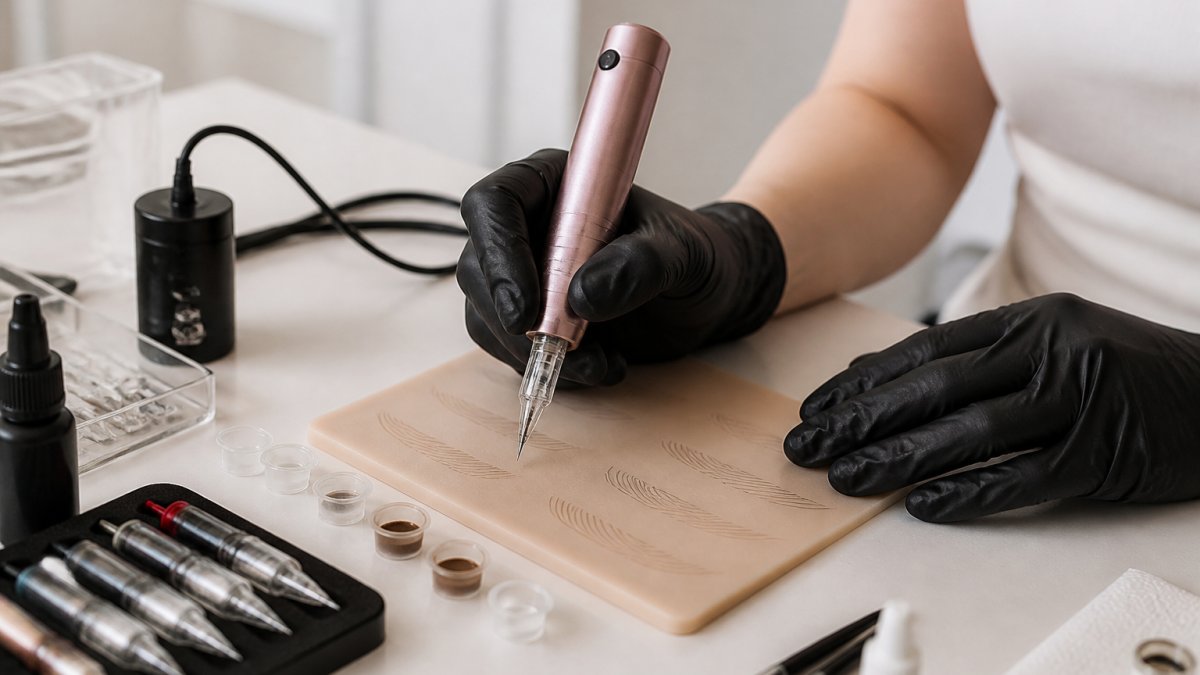
Stroke determines what the machine can do. The Microbeau E.L.B. Adjustable Stroke PMU Machine adjusts from 2.2 mm to 3.4 mm without powering off, with recommended ranges of 2.2-2.8 mm for brows, 2.2-2.5 mm for liner, and 2.8-3.4 mm for lips.

Practice Progression Before You Touch a Client
A machine is not mastered when it arrives, it is mastered after a deliberate practice sequence. The sequence below is a practice progression that many beginners skip, and it helps build control over the machine before working on clients.
Stage 1, Machine familiarization (no pigment). Run the machine on a silicone pad with no cartridge or a spent cartridge to learn the weight, vibration, and hand position.
Stage 2, Line and stroke control on synthetic skin. With a cartridge and no pigment, practice straight lines, curves, and hair-stroke patterns on silicone practice skin. Goal: even spacing and consistent speed without dragging or skipping.
Stage 3, Depth control with pigment on practice skin. Introduce pigment on silicone skins and brow practice pads. Goal: consistent depth that does not overwork the surface, and clean saturation without blowout.
Stage 4, Stroke-range drills. Switch between the brow range (2.2-2.8 mm) and lip range (2.8-3.4 mm) on practice skins to feel how stroke changes hand speed and pigment flow. Goal: adjusting stroke without stopping the machine.
Readiness Checkpoints Before Live-Model Work
Use these checkpoints as gates, not suggestions. A common pattern is to advance only when the prior stage is repeatable on demand:
- You can hold a steady line for a full practice pad without hand fatigue
- Hair strokes are evenly spaced and consistent in depth across a full brow shape
- You can switch stroke settings mid-session without stopping the machine
- You have completed a recognized training course and understand infection-control procedures
- You have confirmed your state's licensing and establishment requirements
If any box is unchecked, stay on practice skins. The machine will still be there when you are ready.
PMU Machine and Needle Compatibility Explained
PMU machine and needle compatibility comes down to one specification: whether the machine accepts universal cartridges. Most modern rotary PMU machines do, which means cartridge choice becomes about needle configuration rather than brand matching.
Universal cartridges fit any rotary machine built to the universal standard. The Mast Pro Universal Needle Cartridges are one option to check against the machines discussed.
Watch out: membrane cartridges prevent backflow, and skipping them is a client-safety problem, not a cost saving. Confirm every box states full membrane and EO gas sterilization before it touches a client.
Permanent Makeup Supplies for Beginners: Pigments, Cartridges, and Hygiene
Pigment selection trips up more beginners than machine choice. Buy a range, not a favorite. A mini set gives you five shades to learn color theory on real skin tones without committing to full bottles. Beginners building a first kit can also browse Perma Blend Brow Pigment Tinas Golden Sunrise to include a trusted brow shade.
Hygiene supplies are non-negotiable and often the largest recurring cost:
- Nitrile gloves, changed between clients
- Barrier film for machine, lamp, and tray
- Single-use ink cups
- Sharps container for cartridges
- Surface disinfectant approved for bloodborne pathogen protocols
In the United States, OSHA's bloodborne pathogens standard governs workplace exposure controls for artists handling blood during procedures. Many states also require a body-art or tattoo establishment license before you work on paying clients; check your state health department's requirements directly, since rules vary widely.
Beginner vs Professional Kits: What Changes as You Grow
Beginner and professional kits differ in three ways: quantity, redundancy, and specialization. A beginner kit, like most PMU starter kits, holds one machine and a sampling of consumables. A working artist's kit holds backup batteries, multiple pigment lines for different skin tones, and cartridge configurations tuned to their signature techniques. But the difference that actually affects a beginner's budget is not what is in the box on day one, it is what the box costs to keep running.
Total Cost of Ownership: The Number Competitors Skip
Most kit listings quote an upfront price and stop there. That number is only the entry fee. A realistic first-year budget has to account for the consumables you will burn through while learning, and those costs recur whether or not you ever take a paying client.
Consumables often outpace the machine during early practice. The recurring line items to plan for:
- Cartridges, practice on synthetic skin consumes cartridges quickly; a 20-cartridge starter count is a sampling, not a supply. Budget for repeat boxes in your preferred configuration once training reveals it.
- Pigments, mini bottles stretch further than full bottles for sampling, but color-theory practice on varied skin tones burns through shades unevenly. Expect to restock your most-used brow shades first.
- Barrier supplies, barrier film, nitrile gloves, and single-use ink cups are consumed on every practice session, not just client work. These are the quietest recurring cost.
- Replacement parts, batteries degrade, and corded machines need cord and adapter replacements over time. Wireless machines trade cord cost for battery cost.
- Practice materials, silicone skins and brow pads are reusable to a point, then need replacing as they lose surface integrity.
Upgrade Triggers, Not Upgrade Timelines
Upgrade when a limitation costs you bookings or blocks a procedure, not on a calendar. Concrete triggers:
Stage |
Machine |
Pigments |
Cartridges |
Upgrade Trigger |
|---|---|---|---|---|
Beginner |
One adjustable-stroke |
Mini set, ~5 shades |
~20 mixed |
Completing training and practice checkpoints |
Intermediate |
Add backup battery or second pen |
Full brow range |
50+ mixed |
Clients with deeper skin tones need shades you lack |
Professional |
Second machine for redundancy |
Multi-line palette |
Bulk by configuration |
A machine failure would cancel booked clients |
Growing into equipment beats buying past your skill level. The machine you learn on should be the machine you outgrow, not the machine you are afraid to touch.
Build Your First Kit with iSLAYBROWSUPPLIES
Assembling a first kit from scratch takes hours of comparison. A curated bundle removes that work. The PMU artist starter bundles from iSLAYBROWSUPPLIES include the essentials for brow and lip work, and the kit can be modified to suit your needs, including machine color and case preference.

These bundles include products with adjustable stroke machines and pigments from established lines. Orders over $150 ship free to the contiguous US.
Frequently Asked Questions
What should a beginner PMU starter kit include?
A working starter kit needs a PMU machine, universal needle cartridges, a small pigment range, disposable ink cups, barrier film and gloves, plus practice materials. iSLAYBROWSUPPLIES offers PMU Artist Starter Bundles at $475.00 and lets you swap colors or the case when stock allows. Add practice skins such as the iSLAY Realistic Silicone Skins at $20.00 before your first paid client, and confirm your kit covers brows, lips, or both.
How do I choose a PMU machine as a beginner?
Start with weight and stroke range. The Biomaser Plenilune U1 Pro weighs 98 grams with a 22mm grip and six stroke settings from 2.0mm to 3.5mm, priced at $269.00. The Microbeau E.L.B. at $299.99 adjusts from 2.2mm to 3.4mm without powering off, with recommended ranges of 2.2mm to 2.8mm for brows and 2.8mm to 3.4mm for lips. A lighter machine with adjustable stroke lets you learn multiple procedures on one device.
Are PMU starter kits suitable for professional use?
They can be, provided the machine and consumables are professional grade. The bundles from iSLAYBROWSUPPLIES contain PMU products of the kind offered in the catalog. What separates a beginner kit from a full professional setup is usually depth of pigment inventory and backup equipment, not quality. Many artists start with a curated bundle and add shades, cartridges, and a second machine as their client base grows.
Do PMU beginners need a complete kit or can they buy supplies separately?
Buying separately gives you control but usually costs more once you add shipping on multiple orders. A bundle covers the essentials in one purchase and often at a lower total. Check what the bundle excludes: practice skins, additional pigment shades, and spare cartridges are common gaps. iSLAY's bundle can be modified to suit individual needs, so ask before ordering if you already own part of the setup.
What should I check before buying a permanent makeup kit?
Confirm needle compatibility first. The Biomaser Pinky Pro cartridges at $16.99 fit any machine that accepts universal cartridges, which covers most rotary PMU devices. Check hygiene supplies are single-use and sterilized, verify the return policy, and confirm the pigment range suits your client base. Also ask whether the kit ships with practice materials, since training on silicone skins before working on clients is standard practice.
The gap between a hobbyist and a working artist usually comes down to whether the first kit covered every category. Start with a bundle that does, then upgrade only when a specific limitation holds you back. Get started with iSLAYBROWSUPPLIES and build a first setup that carries you from training through your first paying clients.
